
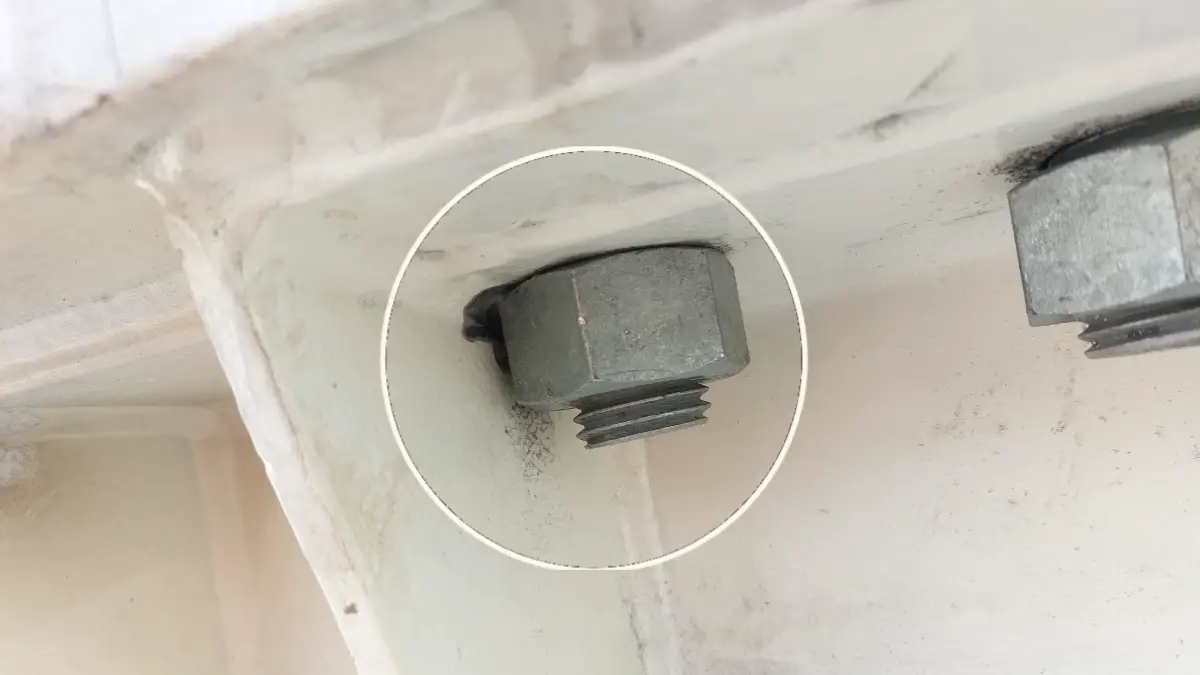
Detailed view of the motor base and mounting bolts, highlighting insufficient bolt clearance. This condition can limit motor movement during alignment and make laser alignment errors difficult to identify.
Improper Motor Base Bolt Clearance: Hidden Laser Alignment Problem
Case Study: Nut Contact With Base Frame Wall Affecting Alignment Repeatability
During precision laser shaft alignment, achieving the correct laser measurement is only part of the job. The motor and pump must also be mechanically installed so that the equipment can be tightened, supported, and maintained in a stable and repeatable condition. The attached photograph shows an important installation problem found underneath a motor base frame.
The nut used to secure the motor base to the base frame was positioned too close to the side wall of the base frame. This restricted the available clearance around the nut and created a potential problem during bolt tightening. Such a condition can affect the final mounting position of the motor and may result in changes to alignment readings when the mounting bolts are tightened or retightened.
The Problem: Restricted Nut Clearance
The motor base was mounted on the base frame with the use of a bolt and nut combination. But upon checking, it was found out that the nut was very near the side wall of the base frame. The clearance space was not enough for a proper tightening process. This is a condition that is often overlooked since the installation of the bolt and nut appears to be okay from the top of the equipment. But the installation of the nut beneath the base frame is just as important. There should be enough clearance for the proper tightening and seating of the nut. Otherwise, the tightening process will be inconsistent.
Why This Matters During Laser Alignment
Laser alignment depends on the real mechanical position of the machine. In case the bolts that hold the motor are not properly tightened, the motor will not be in the same position once the final tightening is done. This poses a very serious challenge to precision alignment.
For example:
Initial alignment → Tightening of bolts → Motor shifts → Alignment changes
The alignment could be right prior to the final tightening, but once the motor shifts due to tightening of bolts, there will be changes in the final shaft alignment. The same applies when rechecking the alignment and mounting condition.
Possible Effect on Alignment and Mounting
In case there is insufficient clearance of the nut, some issues may arise. For example, the bolt may fail to be tightened properly. Uneven contact or interference in the tightening area could also happen. In case of welding spatters, burrs, dirt, and/or rough surfaces on the seating area of the nut, the nut may fail to seat properly. This would mean that the clamping condition would not be consistent. If the mounting condition varies, then the position of the motor will vary. Thus, the end results:
– Horizontal alignment
– Vertical alignment
– Motor position
– Shimming requirements
– Mounting stability
– Alignment repeatability
would be affected.
Welding Burrs and Uneven Surfaces
Base frames that are fabricated will always have welds at the mounting points. After fabrication and welding, one has to examine the mounting and tightening points. Welding burrs, weld spatter, sharp edges, dirt, or an uneven surface might hinder the seating of the washer or nut. A slight obstacle might prevent the fastener from getting into the clamping position. It is for this reason that the mounting point has to be examined and cleaned before conducting laser alignment. This is with the aim of ensuring that the tightening position is clean, smooth, accessible, and mechanically sound.
Don’t Align Against a Loose or Unstable Mounting Condition
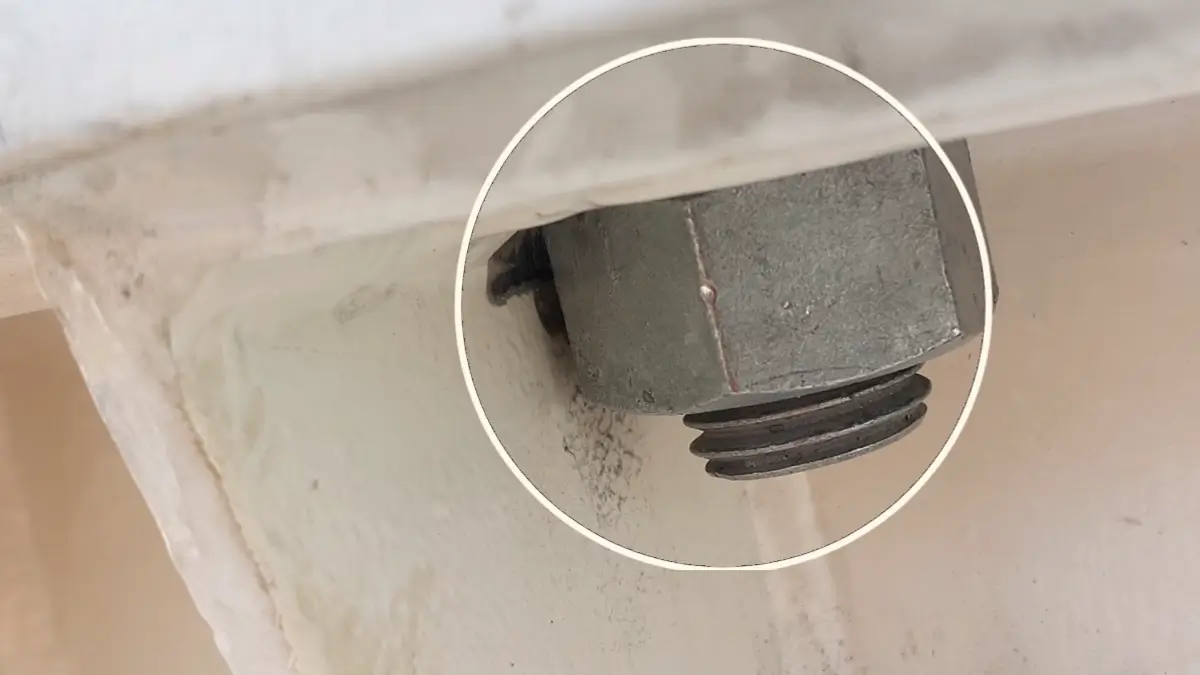
Close-up detail of the motor mounting area where bolt clearance is limited. Insufficient clearance can restrict adjustment of the motor base, potentially resulting in alignment problems that are not immediately visible during laser alignment checks.
A precision laser alignment system can give highly precise measurements. However, the laser cannot compensate for any mechanical issue that may exist during installation. In case the bolt of the motor base cannot be tightened, the final measurement of the alignment will not be an accurate indication of the machine’s real position. This is why alignment engineers must check the entire installation setup before making final adjustments. The right process must be:
Check → Clean → Verify clearance → Tighten properly → Measure → Adjust → Recheck
What Should Be Checked Before Laser Alignment?
Before initiating the final laser alignment of the pump-motor, the motor mounting structure must be examined.
Important examinations include:
1. Clearance of Nut and Bolt: Check whether the clearance between the nut and bolt is adequate for tightening.
2. Washer Alignment: Ensure that the washer is correctly seated and properly contacting the mounting surface.
3. Welding Spatter and Burrs: Remove all welding spatters, burrs, and other obstacles from the tightening area.
4. Cleaning of the Mounting Surfaces: Clean the mounting surfaces of dust, rust, paint deposits, oil, dirt, and other contaminants.
5. Base Frame Condition: Ensure that the fabricated base frame does not hinder the bolt, nut, washer, and motor foot.
6. Motor Feet Contact: Check if the motor feet are appropriately resting.
7. Final Bolt Tightening: Confirm that the mounting bolts can be tightened correctly according to the approved torque procedure.
8. Alignment Recheck: After corrections and making tightening, perform another laser measurement to verify that the machine position has not changed unexpectedly.
Clean and Free Conditions Are Essential
For accurate positioning, the mounting must be as loose and clean as possible.
The following should not happen:
– The nut should not touch the wall of the base frame
– The Washer should not touch the wall of the base frame
– Interference from the bolt
– Welding spurs
– Welding splashes
– Unlevel tightening surfaces
– Dirt on the contact surfaces
– Broken washers
– Inappropriate placement of shims
– Restricted access for tightening
While these might seem like minor issues during fabrication and installation, they may have an effect on the mechanical condition of the machine.
The Importance of Alignment Repeatability
An ideal alignment must be repeatable. Where the alignment readings vary considerably each time the mounting bolts are loosened and tightened, the solution should not just be seen as a matter of aligning the motor. The mounting should be examined for its cause. This could be due to:
– Tightening of bolts
– Nut clearance
– Shimming
– Poor foot contact
– Base frame issues
– Contamination
– Welding deformation
– Uneven mounting surface
Correcting the mechanical cause is better than re-aligning the motor.
Conclusion
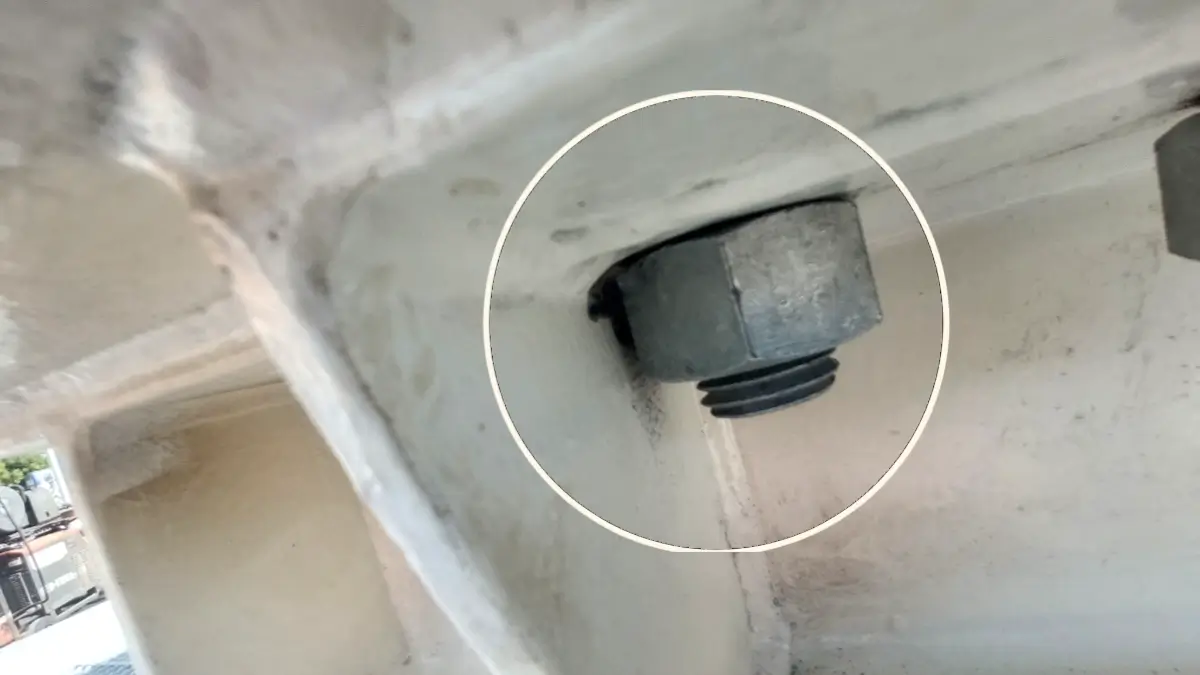
Close-up view of motor base bolts showing inadequate clearance around the motor base. The restricted clearance can interfere with proper motor positioning and contribute to a hidden laser alignment problem.
This picture shows one of the small details that could be easily missed when installing the pump and motor. The nut under the motor base was placed very close to the side wall of the base frame, leaving little room for tightening. If the bolt and nut cannot be tightened to the desired position, then the motor mounting might not be stable or repeatable. Welding burrs, spatter, and an uneven surface for tightening will make it even more difficult for the bolt to seat properly. For laser alignment, the mounting configuration should be checked prior to alignment.
Make the mounting area free, clean, smooth, and accessible. Confirm proper bolt and nut clearance. Tighten correctly. Then perform the laser alignment and verify the final result after tightening. A precision laser alignment is only as reliable as the mechanical condition of the machine being aligned.
Key Takeaway
Prior to laser alignment, one should not only verify the shafts but rather all components securing the machine into place. Correct bolt clearance, clean mounting surfaces, correct shimming, correct seating, and correct tightness are important to achieve the desired alignment result.